Life and career
Rubens trained in Antwerp and studied Italian art before returning to build a large workshop. He worked for churches and courts while also pursuing diplomatic service. His practice relied on collaboration, preparatory sketches and the circulation of designs through prints; the distinction between invention, execution and later reproduction is essential.
Works across a career
Selected examples, not a complete catalogue. Read date ranges and attributions before inferring a career sequence.
- 01
c. 1615
c. 1615
Diana and Her Nymphs Departing for the Hunt
- Material / technique
- oil on canvas
- Attribution / role
- Museum attribution
- Collection / source
- The Cleveland Museum of Art
Museum catalogue note
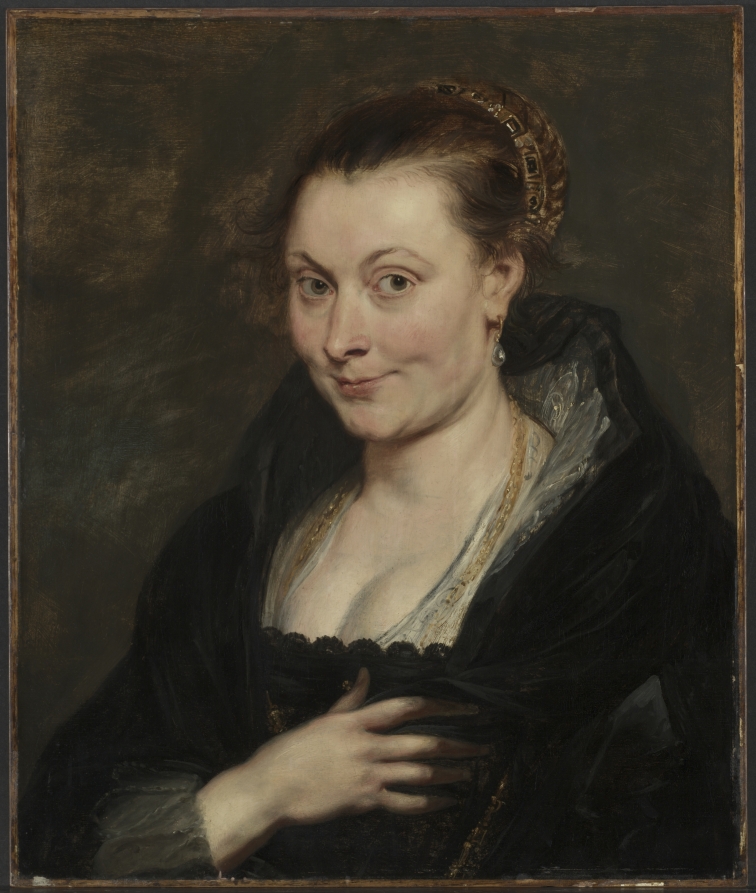
Diana, the Roman goddess of the hunt, wears a crescent on her forehead, also identifying her as the moon goddess. Diana lived apart from men, accompanied by a group of nymphs; she often represented unattainable beauty or chastity. With a nymph at left fending off a lustful satyr, Rubens refers to a struggle between vice and virtue, combining a sensual display of female bodies with a moral undertone. To bring the viewer more fully into the narrative, Rubens pulls the full-bodied figures to the front of the picture plane, and Diana steps forward, activating the space between viewer and subject. The nymph at the right has the features of Isabella Brant, the artist’s wife, and can be compared with Rubens’s portrait of her, also in the museum's collection.
Collection text · The Cleveland Museum of Art · CC0 - 02
c. 1632/35
c. 1632/35
Reconciliation of the Romans and the Sabines (recto) Venus Disarming Mars, Drapery Study (verso)
- Material / technique
- pen and brown ink and brush and gray and brown wash; framing lines in brown ink
- Attribution / role
- Museum attribution
- Collection / source
- The Cleveland Museum of Art
- 03
c. 1639
c. 1639
Study for "The Bear Hunt" (for the Alcázar, Madrid)
- Material / technique
- oil on wood
- Attribution / role
- Museum attribution
- Collection / source
- The Cleveland Museum of Art
Museum catalogue note
On June 22, 1639, King Philip IV of Spain received a letter from his younger brother Ferdinand (1609–1641). The letter explained that the artist Peter Paul Rubens had recently completed all of the sketches for a series of paintings that were to hang in the halls of the Alcázar Palace in Madrid. Bear Hunt is one of seven surviving studies out of the original eighteen. In this scene, a bear attacks a hunter and a companion comes to his aide The others work to stave off a second angry bear. The sketch was completed in the last year Rubens's life, and the paintings for the series were never completed.
Collection text · The Cleveland Museum of Art · CC0
Compare materials, style and colour
Compare the painted hunting scene, the multi-figure drawing and the late Bear Hunt study. Different supports and degrees of finish test movement before or alongside larger projects. Follow diagonals, body turns and the use of light or colour to connect figures; a rapid study can be an intentional tool rather than an incomplete final picture.
Material
What can this material do? Distinguish a design, an original object and a later impression or cast.
Style
Compare viewpoint, edges, composition and marks. Which choices persist, and which change?
Colour
Compare palette, contrast and light. Consider the support, printing, surface treatment and ageing.
Sources and further reading
Original educational interpretation; catalogue descriptions are separately credited. Each study links to its source. Reference entries without images are not added to the comparison timeline.