Life and career
Goltzius was a leading Netherlandish engraver and designer working in Haarlem. His prints display extraordinary control of line and a deep engagement with other artists and classical models. Travel to Italy informed his visual vocabulary; later practice also included painting. His designs circulated widely through print production and later impressions.
Works across a career
Selected examples, not a complete catalogue. Read date ranges and attributions before inferring a career sequence.
- 01
c. 1578
c. 1578
Christ, St. Paul, and the Twelve Apostles
- Material / technique
- Thirteen engravings
- Attribution / role
- Museum attribution
- Collection / source
- The Cleveland Museum of Art
Museum catalogue note
This print series features thirteen engravings depicting Christ and the Apostles (Christ’s primary disciples). In each scene, an apostle is shown in the foreground, with architecture and landscape behind him that indicate the locales in which he preached Christ’s message, from Rome to India. In the middle ground of each print, the apostle’s martyrdom is enacted with multiple figures, while the party responsible for his death—be it king, idol, or devil—looks on. Martyrdom was tied to sainthood in Roman Catholic theology, and martyrdoms appeared frequently in art made after 1563, when the Catholic Church declared that religious art should create empathetic, personal connections to the saints.
Collection text · The Cleveland Museum of Art · CC0 - 02
1592
1592
The Farnesian Hercules
- Material / technique
- engraving
- Attribution / role
- Museum attribution
- Collection / source
- The Cleveland Museum of Art
Museum catalogue note
Hendrick Goltzius was one of many late Renaissance artists who felt compelled to travel to Italy as part of his artistic training. He went with one purpose—to study antique sculpture. Goltzius made drawings on-site and then made engravings after his designs once he returned to Haarlem in 1591. He portrayed the Farnese Hercules from a low viewpoint to capture the awesome experience of first encountering the famous monument. Goltzius showed the sculpture from behind and in shadow, emphasizing its glowing highlights. The print includes two observers, who were assumed by contemporary Dutch commentators to be a self-portrait of Goltzius with his stepson, Jacob Matham, who was also an engraver.
Collection text · The Cleveland Museum of Art · CC0 - 03
c. 1600
c. 1600
Four Small Landscapes: No.4, Cliff on the Seashore
- Material / technique
- woodcut on blue paper
- Attribution / role
- Museum attribution
- Collection / source
- The Cleveland Museum of Art
Compare materials, style and colour
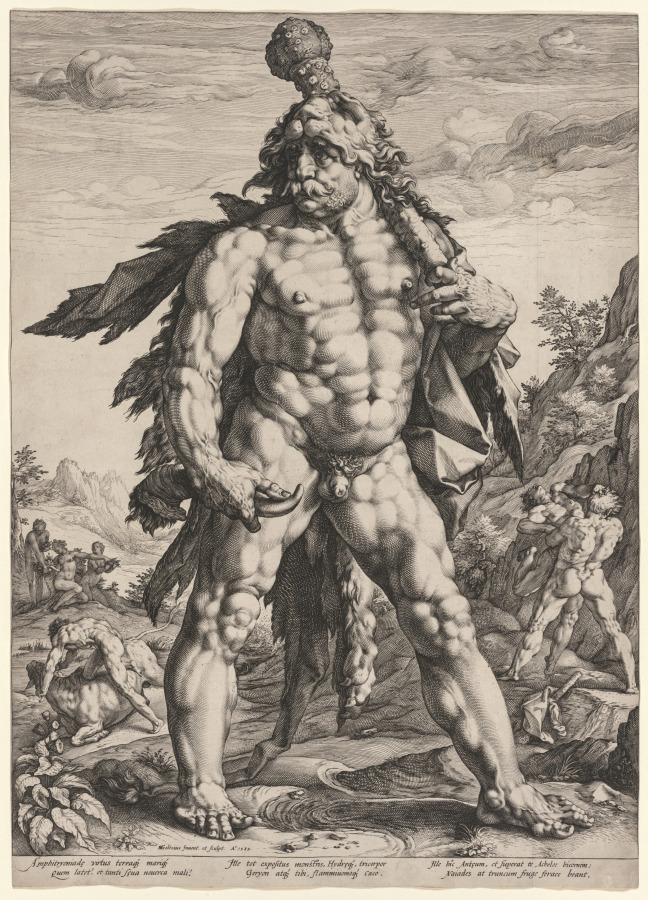
Compare the early apostle series, the 1592 Hercules engraving and the landscape woodcut around 1600. Engraved swelling lines model bodies through controlled incisions; a relief woodcut establishes shapes through a different relation of cut and uncut areas. Monochrome can imply muscular volume or landscape depth without painted local colour.
Material
What can this material do? Distinguish a design, an original object and a later impression or cast.
Style
Compare viewpoint, edges, composition and marks. Which choices persist, and which change?
Colour
Compare palette, contrast and light. Consider the support, printing, surface treatment and ageing.
Sources and further reading
Original educational interpretation; catalogue descriptions are separately credited. Each study links to its source. Reference entries without images are not added to the comparison timeline.