Life and career
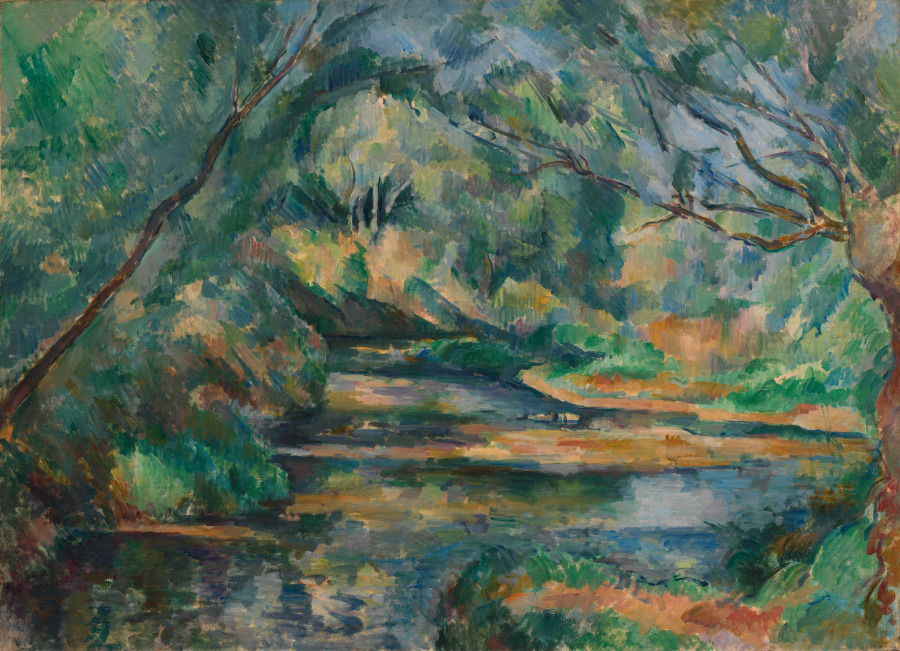
Cézanne developed his practice between Paris and Provence, in dialogue with but never reducible to Impressionism. He repeatedly studied still life, bathers and the landscape near Aix-en-Provence. His later works examine how colour and shifting observations can build a coherent picture without relying on a single frozen viewpoint.
Museum biography (English)
The son of a wealthy banker, Cézanne began his studies in Aix-en-Provence at the École Saint-Joseph in 1849, then attended the Collège Bourbon from 1852 until 1858. Émile Zola, the future author, was to become one of his closest friends. Cézanne enrolled at the École Gratuite de Dessin in 1857, entering the studio of Joseph Gibert (1806-1884). Two years later, complying with his father's wishes, he began studying law at the Université d'Aix while still at the École Gratuite de Dessin. In 1861 Cézanne finally left law school and followed Zola to Paris where he met Pissarro (q.v.) at the Académie Suisse. Probably after his failure to enter the École des Beaux-Arts, he returned to Aix and began working at his father's bank. In 1862, however, Cézanne returned to Paris, where he studied at the Académie Suisse and copied the works of the Old Masters in the Louvre. The works he produced during this period reflect the influence of Spanish painters such as Ribera (1591-1562) and Zurbarán (1598-1664), and other predecessors such as Delacroix (q.v.). His submissions to the Salons of 1865 through 1870 (and even through 1881) did not receive the jury's approval; the reinstatement of the Salon des Refusés was repeatedly but unsuccessfully demanded. Cézanne traveled often between Aix and Paris until 1870. To escape the Franco-Prussian War (1870-71) he stayed in the south in L'Estaque, along with his mistress, Hortense Fiquet, whom he had met in 1869. Cézanne moved back north to Pontoise with Hortense and his son, Paul, in 1872 and worked with Pissarro and met Dr. Paul Gachet. The following year he moved again to nearby Auvers-sur-Oise with his family, continuing his work with Pissarro. In 1874 and 1877 Cézanne participated in the first and third impressionist exhibitions, but the severe criticism of his works led him to abstain from using this venue again. In 1878 his father learned of the existence of Hortense and Paul, who at that point were living in Marseille, and threatened to discontinue his allowance. While in the Midi, Cézanne often worked with Monticelli (q.v.). His art increasingly matured, and he began concentrating on the order and internal structure within his compositions, limiting his palette. During these years he also met Gauguin (q.v.) and Renoir (q.v.), and always trav-eled, chiefly between Aix and L'Estaque. In 1886 Cézanne married Hortense, his father died, and the inheritance provided him with the financial means to live without constraints. He bought a house in Marlotte near Fontainebleau in 1892. In 1895 he had his first solo show at the gallery of Ambroise Vollard, who two years later bought all the artist's works from his studio near Corbeil. The dealer Paul Durand-Ruel became another important client. Cézanne participated in the Salon des Indépendants in 1899, 1901, and 1902 and exhibited at La Libre Esthétique in Brussels in 1901 and 1904, the Secession in Vienna in 1903, and the Salon d'Automne in 1904-6. He continued to study the underlying structure of nature, at times approaching abstraction by denying traditional perspective and using multiple viewpoints. He also began leaving portions of the canvas bare, giving some works an unfinished appearance. Cézanne's work had a tremendous influence on the artists of his time as well as those of subsequent generations, and he is considered one of the most influential figures in the development of modern art.
Creator biography · The Cleveland Museum of Art · CC0Works across a career
Selected examples, not a complete catalogue. Read date ranges and attributions before inferring a career sequence.
- 01
1871–76
1871–76
Sheet of Studies
- Material / technique
- graphite and pen and brown ink
- Attribution / role
- Museum attribution
- Collection / source
- The Cleveland Museum of Art
- 02
1890
1890
The Pigeon Tower at Bellevue
- Material / technique
- oil on fabric
- Attribution / role
- Museum attribution
- Collection / source
- The Cleveland Museum of Art
Museum catalogue note
Paul Cezanne painted this composition in three horizontal planes: the azure blue of the sky; the luminous white of the tower and the farmyard buildings; and the burnt-orange shade of the foreground earth, whose color is indicative of the iron-rich soil of Provence. The shimmering greens of Cezanne’s favorite cypress and olive trees are interspersed across the middle ground. The composition is pared down to its essentials, devoid of extraneous detail; it exemplifies his ambition “to make something solid and enduring, like the art in museums.”
Collection text · The Cleveland Museum of Art · CC0 - 03
c. 1904
c. 1904
Mount Sainte-Victoire
- Material / technique
- oil on fabric
- Attribution / role
- Museum attribution
- Collection / source
- The Cleveland Museum of Art
Museum catalogue note
During the last 20 years of his life, Cezanne repeatedly painted Mount Sainte-Victoire near his home in Aix-en-Provence in southern France. Cezanne painted this view from life at one of his favorite sites, a small road that led from Aix eastward toward Mount Sainte-Victoire. He set up his easel at the edge of the road where he could see two umbrella pines and the mountain towering over the scene. A branch of one of the pines extends from the left of the canvas across the sky, echoing the slope of the mountain, linking the near and the far.
Collection text · The Cleveland Museum of Art · CC0
Compare materials, style and colour
The study sheet makes exploratory drawing visible; the 1890 tower separates the landscape into strong horizontal relations; the late Sainte-Victoire links mountain and surrounding space through colour patches. Compare line, exposed support and the edges between planes. The later oil paintings construct depth without smoothing away every visible decision.
Material
What can this material do? Distinguish a design, an original object and a later impression or cast.
Style
Compare viewpoint, edges, composition and marks. Which choices persist, and which change?
Colour
Compare palette, contrast and light. Consider the support, printing, surface treatment and ageing.
Sources and further reading
Original educational interpretation; catalogue descriptions are separately credited. Each study links to its source. Reference entries without images are not added to the comparison timeline.