Life and career
Kōrin came from a Kyoto textile-merchant family and studied earlier designs associated with Sōtatsu and Kōetsu. His mature work crossed painting and designed objects, while collaboration with his brother Kenzan linked pictorial ideas to ceramics. Later Rinpa artists revived his example through selective study, not a continuous hereditary school.
Works across a career
Selected examples, not a complete catalogue. Read date ranges and attributions before inferring a career sequence.
- 01
c. 1700
c. 1700
Plum Tree
- Material / technique
- hanging scroll; ink on silk
- Attribution / role
- Museum attribution
- Collection / source
- The Cleveland Museum of Art
Broad or uncertain date: not a secure career stage.
John L. Severance Fund · Image: public domain (CC0)Museum catalogue note
Ogata Kōrin had to think through his design carefully to create these white plum blossoms and deliver their effect, as he used the reserve technique—where selected areas of the painting surface are left unpainted—to achieve it. He probably roughed in the tree before applying an ink wash to the entire silk surface, except where he intended to place the flowers. He likely then returned to articulate the petals and, in some cases, the pistils and stamens. The composition shows the tree twisting out of view, only to return with a branch of new growth jabbing forth from an old, broken limb, thereby heightening the visual impact of the blossoms.
Collection text · The Cleveland Museum of Art · CC0 - 02
c. 1700
c. 1700
Square Dish with Design of Plovers over Waves
- Material / technique
- Glazed stoneware with iron oxide underglaze slip
- Attribution / role
- Designed by; made with specialist craftspeople
- Collection / source
- The Cleveland Museum of Art
Museum catalogue note
The Ogata brothers Kōrin and Kenzan often collaborated on ceramics. This dish is one of a set used for serving tea cakes. Kenzan shaped the dish, after which Kōrin drew the iron oxide design of plovers, a type of shorebird, flying over waves. Kenzan then covered the object with a clear glaze and fired it. Kōrin placed his signature next to his design, while Kenzan signed the back.
Collection text · The Cleveland Museum of Art · CC0 - 03
after 1709
View this work at the source
Reference entry · image not reproducedafter 1709
Irises at Yatsuhashi (Eight Bridges)
- Material / technique
- Pair of six-panel folding screens; ink and colour on gold leaf on paper
- Attribution / role
- Museum attribution
- Collection / source
- The Metropolitan Museum of Art
Compare materials, style and colour
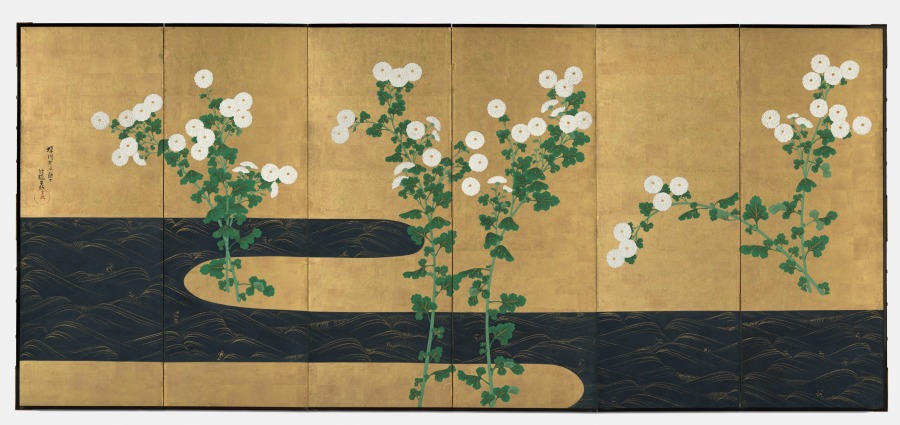
Compare ink plum branches, the glazed dish and the later gold-ground iris screens. Brush-made asymmetry can operate on silk, a shaped ceramic object or a large folding surface. Colour changes with glaze, ink and metallic ground. The dish has collaborative authorship, while “after 1709” is a date boundary, not an exact year.
Material
What can this material do? Distinguish a design, an original object and a later impression or cast.
Style
Compare viewpoint, edges, composition and marks. Which choices persist, and which change?
Colour
Compare palette, contrast and light. Consider the support, printing, surface treatment and ageing.
Sources and further reading
Original educational interpretation; catalogue descriptions are separately credited. Each study links to its source. Reference entries without images are not added to the comparison timeline.