Life and career
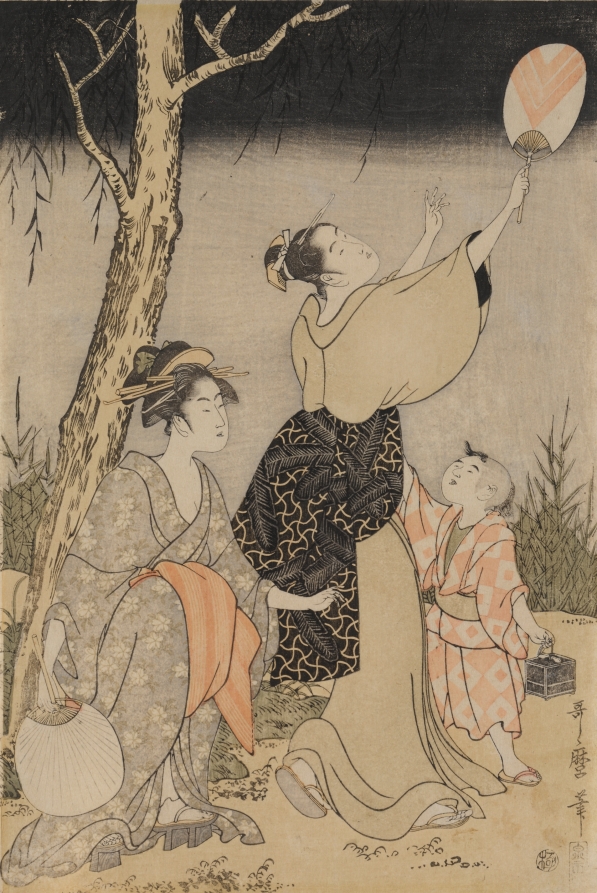
Utamaro became a leading designer of images of women in late-eighteenth-century Edo. Publishers and the fashion and entertainment industries shaped his audiences. He developed close views of faces as well as more elaborate figure scenes. The surviving prints reveal constructed social types and roles, rather than transparent records of women’s private lives.
Works across a career
Selected examples, not a complete catalogue. Read date ranges and attributions before inferring a career sequence.
- 01
c. 1793
c. 1793
The Flirtatious Type, from Ten Types in the Physiognomy of Women
- Material / technique
- color woodblock print
- Attribution / role
- Museum attribution
- Collection / source
- The Cleveland Museum of Art
Museum catalogue note
Kitagawa Utamaro was well known for his close-up portraits that belonged to a genre, or category, of images called bijinga (pictures of beautiful people). This print is from a series that invites comparisons of the attractiveness of different figures. It comes from a series that assigns personality traits to women based on their physical appearance.
Collection text · The Cleveland Museum of Art · CC0 - 02
c. 1798
c. 1798
Takigawa of the Ōgiya from the series A Selection of Eastern Beauties
- Material / technique
- color woodblock print
- Attribution / role
- Museum attribution
- Collection / source
- The Cleveland Museum of Art
Museum catalogue note
The courtesan Takigawa worked for the Ōgiya, "House of Fans" brothel, one of the most prestigious in the Yoshiwara. Here, she smokes tobacco, a fashionable trend in 18th-century Edo. Fashion-conscious women in Edo purchased prints of the most famous beauties just as contemporary women buy fashion magazines to learn about the latest styles in make-up and hair. The strands of hair at her temple were printed from thin pieces of wood left in relief when the areas on either side of them were carved away.
Collection text · The Cleveland Museum of Art · CC0 - 03
1806
1806
Woman Reading a Letter (from the series Seven Episodes in the Life of Komachi in the Floating World)
- Material / technique
- color woodblock print
- Attribution / role
- Museum attribution
- Collection / source
- The Cleveland Museum of Art
Compare materials, style and colour
Compare the face and gesture in the 1793 design, the fashionable figure of the later 1790s, and the letter reader of 1806. Outline and patterned dress remain crucial within colour woodblock printing. Ask how much psychological individuality comes from a small turn of the head rather than naturalistic shading.
Material
What can this material do? Distinguish a design, an original object and a later impression or cast.
Style
Compare viewpoint, edges, composition and marks. Which choices persist, and which change?
Colour
Compare palette, contrast and light. Consider the support, printing, surface treatment and ageing.
Sources and further reading
Original educational interpretation; catalogue descriptions are separately credited. Each study links to its source. Reference entries without images are not added to the comparison timeline.