early–mid 1900s
Dates overlap and vary by place; they are not strict boundaries.
The artist claims the whole process
Self-designing, carving and printing promoted a model of personal expression. Actual practices varied, so the ideal should not erase collaboration or imply that it was less valuable.
Associations are checked against museum records rather than assigned from dates alone.
Why it emerged
In early-twentieth-century Japan, artists promoted prints as personal expression, often designing, carving and printing their own work. Little magazines, exhibitions and the 1918 Japan Creative Print Association supported exchange. This ideal differed from the divided labour of commercial print publishing, although individual artists’ working arrangements were more varied than the slogan suggests.
Key artists and contributions
Yamamoto Kanae
His 1904 Fisherman became an important early example for the creative-print movement.
Onchi Kōshirō
Explored abstract form and promoted printmaking through publications and artistic networks.
Hiratsuka Un’ichi
Made forceful black-and-white woodcuts central to a long independent practice.
View artwork at museumReference entry · image not reproducedREPRESENTATIVE WORKByodo-in Lakeside (plate, facing page 16) from The Modern Japanese Print ↗
1962
The Museum of Modern Art
What changed afterwards
Creative-print networks helped establish the modern artist’s print as a distinct field and encouraged experimentation beyond familiar ukiyo-e subjects. The history invites comparison with collaborative publishing without assuming that individual authorship is inherently more valuable.
Sources and further reading
Original educational overview, informed by the resources below. Artist examples are selective; they are not a complete membership list.
Works in this collection
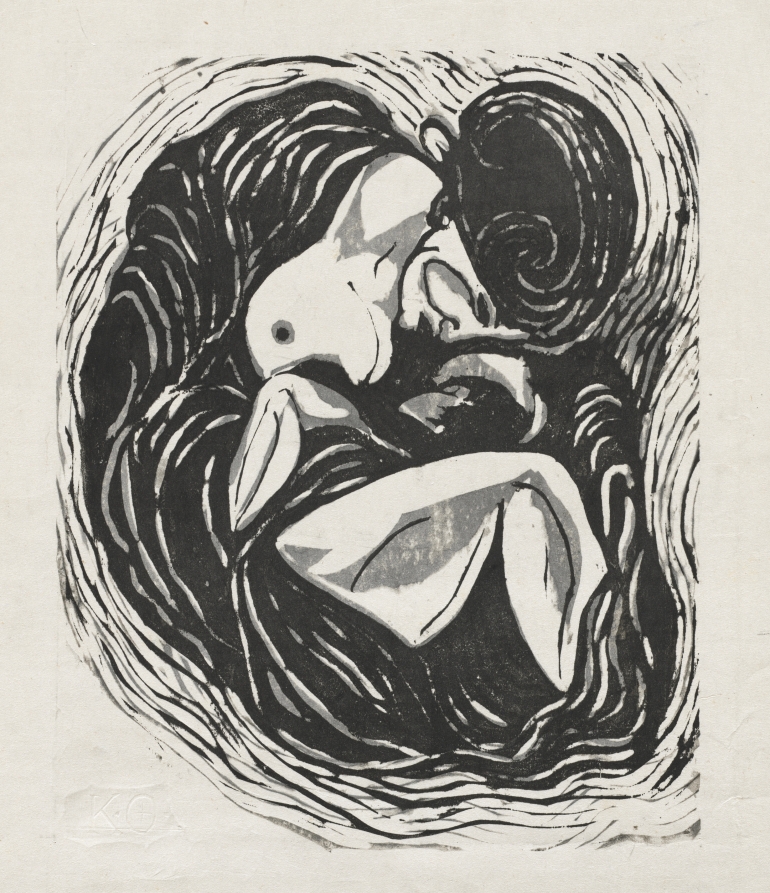
Movement and school labels are interpretive tools. Individual works can cross boundaries, and an artist’s entire career is not assigned to a single movement.