Life and career
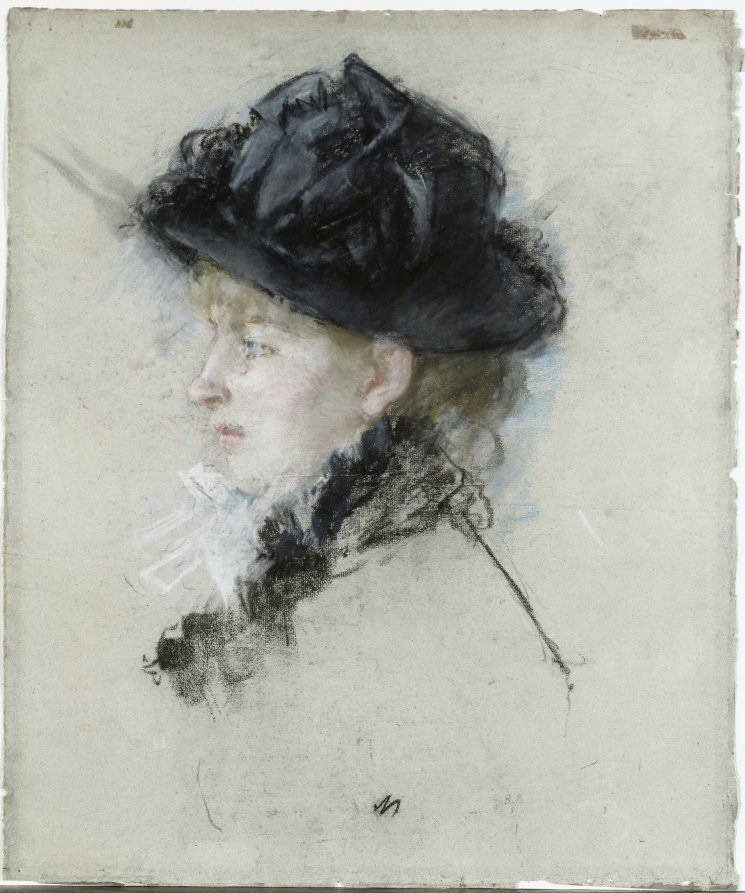
Morisot trained as a painter within the restrictions facing women in nineteenth-century France and became a founding participant in the Impressionist exhibitions. Her subjects included relatives, gardens and domestic or suburban life. Later work increasingly used open handling and lively drawing, while subjects and media remained varied.
Museum biography (English)
Born into a prosperous family, Berthe Morisot was encouraged at an early age to become an amateur artist. Along with her sister Edma, she began her studies with Geoffroy-Alphonse Chocarne (act. 1838-1857), a painter trained in the neoclassical tradition. In 1858 the sisters entered the studio of Joseph-Benoît Guichard (1806-1880), a student of Ingres (q.v.) and Delacroix (q.v.). Through Guichard they met Corot (q.v.) in 1861, under whose encouragement they began to paint out of doors near Pontoise as well as in Normandy and Brittany. Berthe Morisot exhibited at the Salon from 1864 until 1873. Fantin-Latour (q.v.) introduced her to Manet (q.v.) around 1867. They developed a close friendship, and Morisot modeled for him many times (see Manet, Berthe Morisot, no. 141). In 1874 she married his brother, Eugène, and that same year began participating in the impressionist exhibitions, never to show at the Salon again. Four years after their marriage, the couple's only child, Julie, was born on 14 November 1878 and would become a main source of artistic inspiration. Morisot matured as a central member of the group of impressionists. Her home became a meeting place for painters and writers alike, including Renoir (q.v.), Degas (q.v.), Mary Cassatt (1845-1926), and Stéphane Mallarmé. She participated in the Drouot sale of 1875, where the artists were ridiculed extensively. Her paintings, however, fetched slightly higher prices than those of Renoir, Monet (q.v.), and Sisley (q.v.). Morisot made pastels and watercolors as well as oil paintings, and during the final years of her life she experimented with lithography and drypoint etching.
Creator biography · The Cleveland Museum of Art · CC0Works across a career
Selected examples, not a complete catalogue. Read date ranges and attributions before inferring a career sequence.
- 01
1873
1873
Reading
- Material / technique
- oil on canvas
- Attribution / role
- Museum attribution
- Collection / source
- The Cleveland Museum of Art
Museum catalogue note
Morisot’s sister, Edma, posed for this painting of a woman seated on her shawl in a field, her eyes on the pages of a book, with a parasol and fan discarded on the grass. Her white dress reflects the light and shadows of the outdoor setting; its delicate floral pattern echoes the meadow’s wildflowers.X-ray examination reveals that Morisot revised Edma’s eyes, which previously looked directly at the beholder, in a manner more typical of Manet’s figures (see The Railway on view in this gallery). Whereas women in Manet’s paintings often return the viewer’s look, Morisot’s figures are usually absorbed in tasks or private reflection.
Collection text · The Cleveland Museum of Art · CC0 - 02
1889
1889
The Drawing Lesson (Berthe Morisot Drawing with Her Daughter)
- Material / technique
- drypoint
- Attribution / role
- Museum attribution
- Collection / source
- The Cleveland Museum of Art
Museum catalogue note
Encouraged by the Impressionist Mary Cassatt and the poet Stéphane Mallarmé, Morisot experimented with printmaking between 1887 and 1889. In this drypoint, a technique in which a sharp tool is used to scratch lines onto a copper plate, Morisot looks directly at the viewer—as if drawing our portrait—while 11-year-old Julie observes her mother at work.
Collection text · The Cleveland Museum of Art · CC0 - 03
1890
1890
Young Saint John
- Material / technique
- pastel on pale blue laid paper
- Attribution / role
- Museum attribution
- Collection / source
- The Cleveland Museum of Art
Museum catalogue note
In the spring of 1890 Berthe Morisot and her husband, Eugène Manet, rented a house with a garden overlooking the Seine River in the rural French town of Mézy. Morisot worked in the attic studio while the pair was there. A young boy from the village served as the model for this pastel, one of several studies for a full-length painting of Saint John the Baptist with his cross. In this drawing, Morisot developed the loose and sketchy marks that would characterize her final canvas.
Collection text · The Cleveland Museum of Art · CC0
Materials, marks and colour
Media and surface
Oil, drypoint and pastel allow different kinds of openness and revision.
Marks and structure
Loose, rapid-looking marks coexist with deliberate framing of figures, clothing and domestic space.
Palette and light
Light fabrics carry reflected colour; pale passages are enlivened by darker, mobile accents.
Sources and further reading
Original educational interpretation; catalogue descriptions are separately credited. Each study links to its source. Reference entries without images are not added to the comparison timeline.