Life and career
Hokusai trained in the commercial print culture of Edo and worked under several artistic names. His career extended from actor and figure designs to illustrated books, landscapes and painting. The Thirty-Six Views of Mount Fuji brought ambitious landscape printing to a broad audience late in his life; he continued painting into old age.
Works across a career
Selected examples, not a complete catalogue. Read date ranges and attributions before inferring a career sequence.
- 01
1799
1799
Tsukasa and Other Courtesans of the Ogiya Watching the Autumn Moon Rise Over Rice Fields from a Balcony in the Yoshiwara
- Material / technique
- Surimono; color woodblock print
- Attribution / role
- Museum attribution
- Collection / source
- The Cleveland Museum of Art
Museum catalogue note
Gomeirō is another name for the fashionable teahouse Ōgi-ya (House of Fans) in the Yoshiwara district of Edo (present-day Tokyo). Two courtesans, each attended by a geisha and a shinzō (apprentice to a courtesan) view a full autumn moon as it rises over the surrounding paddy fields. The elegance of the women's flowing robes and the serenity of the evening with a full silver moon contribute to the poetic atmosphere of this surimono, a privately commissioned print usually accompanied by text—here, a poem, which reads:What liveliness! Geisha, shinzō, and jesters fill the room, all guests of the moon.
Collection text · The Cleveland Museum of Art · CC0 - 02
early 1830s
early 1830s
South Wind, Clear Sky, from Thirty-Six Views of Mount Fuji
- Material / technique
- color woodblock print
- Attribution / role
- Museum attribution
- Collection / source
- The Cleveland Museum of Art
Museum catalogue note
Mt. Fuji, Japan’s highest mountain, appeared in most Japanese 19th-century travel literature. Maps sometimes showed its location with a Fuji-shaped icon and indicated where travelers could get the best view of it. Between 1829 and 1833, Hokusai created a print series depicting thirty-six views of the mountain, including this one, sometimes known as “Red Fuji.” The season in this scene is a time between late summer and early autumn, when the mountain takes on a reddish hue.
Collection text · The Cleveland Museum of Art · CC0 - 03
1835–36
1835–36
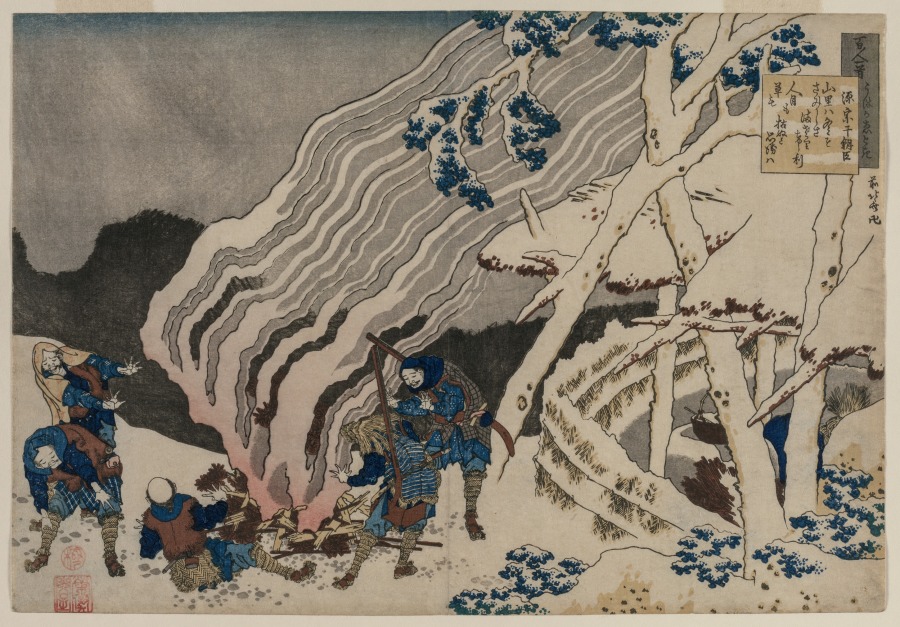
Poem by Fujiwara no Yoshitaka, from the series One Hundred Poems by One Hundred Poets Explained by an Old Nurse
- Material / technique
- Color woodblock print
- Attribution / role
- Museum attribution
- Collection / source
- The Cleveland Museum of Art
Materials, marks and colour
Media and surface
Colour woodblocks build images through registered impressions from separately inked blocks.
Marks and structure
Decisive contours and large simplified shapes organise figures, waves and mountains.
Palette and light
Restricted colour contrasts and unprinted paper can create depth without continuous modelling.
Sources and further reading
Original educational interpretation; catalogue descriptions are separately credited. Each study links to its source. Reference entries without images are not added to the comparison timeline.