Life and career
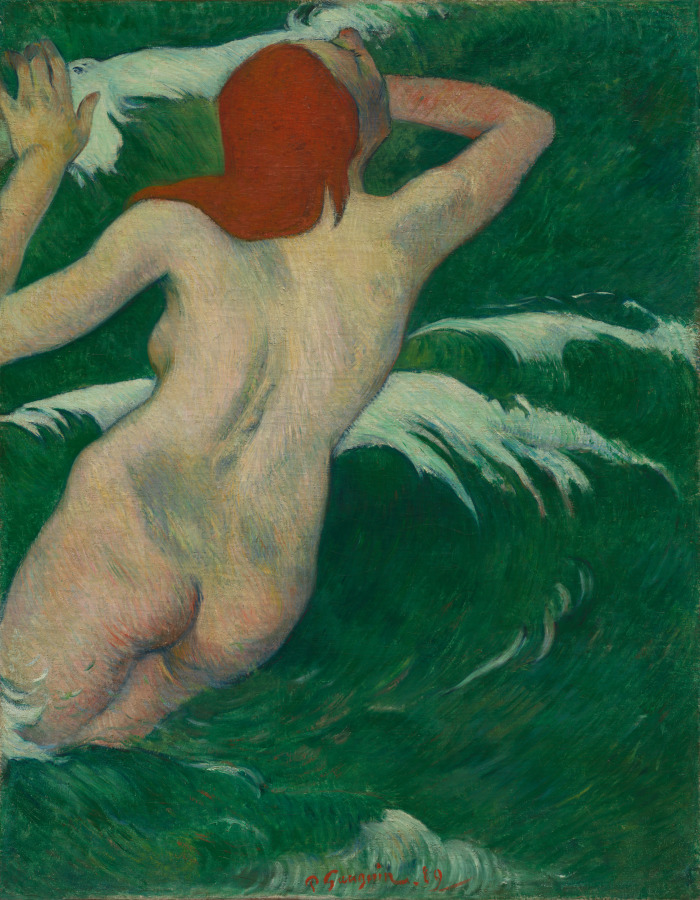
Gauguin left a career in finance to pursue art and worked among artists in France before travelling to Tahiti and the Marquesas. His painting increasingly combined simplified colour with symbolic subjects. His Polynesian works must also be understood within French colonial power and the unequal relationships that shaped his life there.
Museum biography (English)
Gauguin spent the first seven years of his life with his mother and great uncle in Peru. In 1855 his mother took him back to France where he attended boarding school. He joined the merchant marine when he was seventeen and began traveling around South America. When Gauguin's mother died in 1868, Gustave Arosa, an art collector and photographer, became his legal guardian. Arosa's collection included works by Corot (q.v.), Courbet (q.v.), Delacroix (q.v.), and the Barbizon painters, and it was he who would encourage Gauguin to start painting. In 1872 Arosa found a job for Gauguin at a brokerage firm, giving him financial security. The following year he married a Danish woman, Mette Gad. Gauguin had already started painting and sculpting in his spare time and first exhibited at the Salon in 1876 with a landscape.1 He was asked by Pissarro (q.v.) and Degas (q.v.) to participate in the fourth impressionist exhibition in 1879, where from then on he would exhibit regularly. Durand-Ruel began purchasing his paintings, and in turn Gauguin started to collect the works of his colleagues, such as Manet (q.v.) and Renoir (q.v.) and, in particular, Cézanne (q.v.) and Pissarro. He went to Pontoise in 1882, where he painted with Cézanne and Pissarro, who along with Degas continued to influence him at this period. In 1883 Gauguin decided to become a full-time artist. In 1884 he moved with his wife and children to Rouen and then to Copenhagen, but he failed to earn a comfortable living. He returned to Paris in 1886 and met ceramicist Ernest Chaplet (1835-1909), who introduced him to his métier. Gauguin distanced himself from impressionism and in 1888 worked in Pont-Aven with Émile Bernard (1868-1941), who had been experimenting with creating compositions using flat areas of color and dark outlines (cloissonism). Gauguin also studied Japanese prints and Indonesian art. The impact of these influences is evident in Gauguin's Vision after the Sermon: Jacob Wrestling with the Angel (1888, National Gallery of Scotland, Edinburgh), so far removed from his earlier impressionist style. Succumbing to van Gogh's (q.v.) many requests, Gauguin agreed to travel to Arles and paint with the artist; their characters, however, proved incompatible. Theo van Gogh, who worked for Boussod Valadon & Cie, would in the meantime sell Gauguin's work. For the next two years, Gauguin traveled often around Brittany. In search of a more pure and unspoiled culture, he auctioned off his paintings in 1891 in order to finance a journey to Tahiti. Upon his arrival, he was disappointed to find many expatriates and developed areas, yet he was still able to capture in his works an uncultivated spirit. He not only made paintings but also created bold woodcuts and sculptures and was an avid writer. Gauguin returned to France in 1893, where he was given a solo exhibition by Durand-Ruel that was not particularly successful. He decided to leave Europe again in 1895, moving to Tahiti and later to Hivaoa, a more remote island in the Marquesas. Because he abandoned naturalistic colors and used formal distortions in order to achieve expressive compositions, Gauguin's work became an inspiration for many subsequent artists. 1. Possibly Wildenstein 1964, no. 12.
Creator biography · The Cleveland Museum of Art · CC0Works across a career
Selected examples, not a complete catalogue. Read date ranges and attributions before inferring a career sequence.
- 01
1870s
1870s
Mother and Child (recto)
- Material / technique
- black chalk
- Attribution / role
- Museum attribution
- Collection / source
- The Cleveland Museum of Art
- 02
1891
1891
Head of a Tahitian Woman
- Material / technique
- graphite with stumping and graphite wash on parchment
- Attribution / role
- Museum attribution
- Collection / source
- The Cleveland Museum of Art
Museum catalogue note
This drawing belongs to a group of highly finished portrait drawings of Tahitians made by Paul Gauguin shortly after his arrival in the South Seas. While getting used to this new place, Gauguin initially avoided painting, preferring first to familiarize himself with the landscape and people through observation and drawing. The meticulous quality of this graphite study suggests that it was made from life. The woman’s noble face and enigmatic expression allude to the spirituality and melancholy that Gauguin sought to conjure in his Polynesian work.
Collection text · The Cleveland Museum of Art · CC0 - 03
1902
1902
The Call
- Material / technique
- oil on canvas
- Attribution / role
- Museum attribution
- Collection / source
- The Cleveland Museum of Art
Museum catalogue note
Painted on a remote island in Polynesia a year before the artist's death, The Call belongs to a series of late works that explore the mysteries of life and death. Two women stand with bare feet, as if on sacred ground. One woman gestures to someone outside the picture, perhaps responding to a "call" from fate or destiny. Gauguin realized his ambition of painting from memory and the imagination through such mysterious, dreamlike images.
Collection text · The Cleveland Museum of Art · CC0
Compare materials, style and colour
The early chalk study relies on tonal drawing; the 1891 head and 1902 painting use different kinds of presence and narrative. Compare flat areas, outlines and the relationship between figures and setting. Colour can carry a symbolic mood without providing reliable evidence of the sitter’s inner life or an authentic, timeless culture.
Material
What can this material do? Distinguish a design, an original object and a later impression or cast.
Style
Compare viewpoint, edges, composition and marks. Which choices persist, and which change?
Colour
Compare palette, contrast and light. Consider the support, printing, surface treatment and ageing.
Sources and further reading
Original educational interpretation; catalogue descriptions are separately credited. Each study links to its source. Reference entries without images are not added to the comparison timeline.