from 1917
Dates overlap and vary by place; they are not strict boundaries.
Harmony did not mean agreement
Lines, planes and colour promised a shared visual order. Artists still disagreed about how to achieve it, including whether diagonal lines belonged in that language.
Associations are checked against museum records rather than assigned from dates alone.
Why it emerged
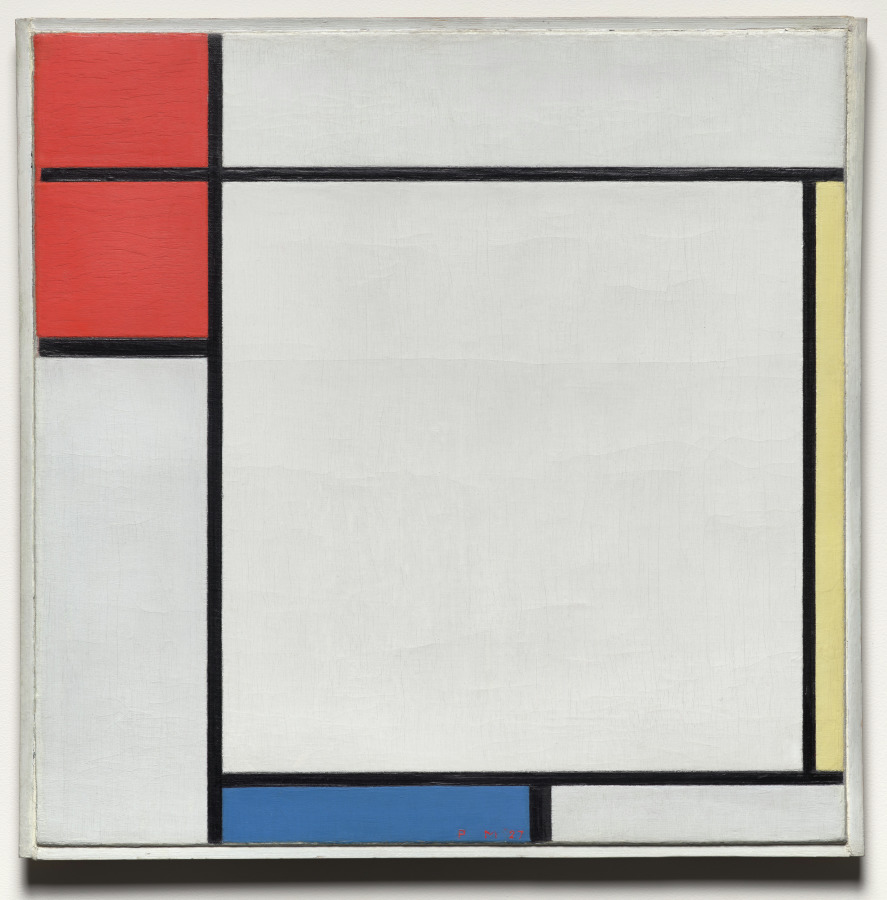
Founded around a Dutch journal in 1917, De Stijl connected artists and designers seeking a new, broadly shared visual order during a period of war and upheaval. They reduced compositions to relationships among lines, planes and colour. Their search for harmony produced disagreement too, including over the use of diagonals.
Key artists and contributions
Piet Mondrian
Developed dynamic balance through verticals, horizontals and carefully adjusted colour planes.
Theo van Doesburg
Promoted the journal, interdisciplinary exchange and later diagonal compositions.
View artwork at museumReference entry · image not reproducedREPRESENTATIVE WORKRhythm of a Russian Dance ↗
June 1918
The Museum of Modern ArtGerrit Rietveld
Translated relationships of independent planes into furniture and architecture.
View artwork at museumReference entry · image not reproducedREPRESENTATIVE WORKRed Blue Chair ↗
1918–1923
The Museum of Modern Art
What changed afterwards
The group helped connect abstract painting with modern interiors, architecture and graphic design. Later commercial uses often borrowed its visual vocabulary while leaving behind its ambitious theories of social and spiritual harmony.
Sources and further reading
Original educational overview, informed by the resources below. Artist examples are selective; they are not a complete membership list.
Works in this collection
Movement and school labels are interpretive tools. Individual works can cross boundaries, and an artist’s entire career is not assigned to a single movement.