 ↗
Japan, Edo period (1615–1868) · late 1790s
Cherry Blossoms in the Wind
Utagawa Toyokuni
#D3C8B5#D5CBB8#9F9383#C7BBA9#D0C4B2#E3D9C3Estimated from six colour groups in the museum image, including visible paper or borders. Reproduction and lighting affect the result; these are image-area proportions, not pigment measurements.
Bequest of Mrs. A. Dean Perry · The Cleveland Museum of Art
Image: public domain (CC0) · Museum record & image source ↗
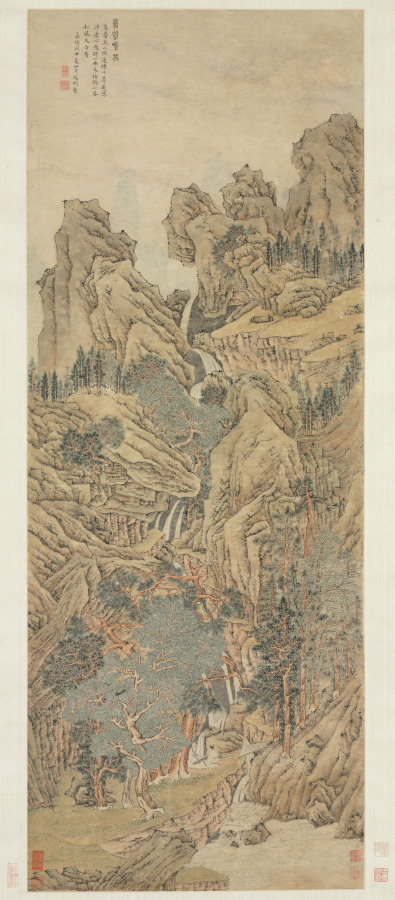
Wen Zhengming was one of the most celebrated calligraphers and painters during the Ming dynasty (1368–1644). His inscription, gracefully written in small characters on the upper left corner, reveals Wen’s emotional mood at that moment of creation. "In the fifteenth day of the fifth month, the year of xinhai [1551], [I], Zhengming, playfully write this Old Trees by a Wintry Brook at eighty-two [sui]." How should we understand a wintery landscape painted in the middle of spring? Was it simply inspired by a surprisingly late spring snow? Or can it be that the “wintery” brook reflects the octogenarian’s feelings about aging and his inevitable, approaching mortality? The junipers’ gnarled forms are a poignant symbol of aging and suffering, yet the ink-dot leaves on some branches suggest that the trees are still alive, awaiting the warmth of spring.
Collection text · The Cleveland Museum of Art · CC0Start with what you can see: shapes, surface, colour and scale. How might the listed materials affect the way this object was made and experienced?
Looking prompt · an invitation to observe, not a historical interpretation.↗Utagawa Toyokuni
 ↗
Shen Zhou
 ↗
Shitao
 ↗
Wen Zhengming