 ↗
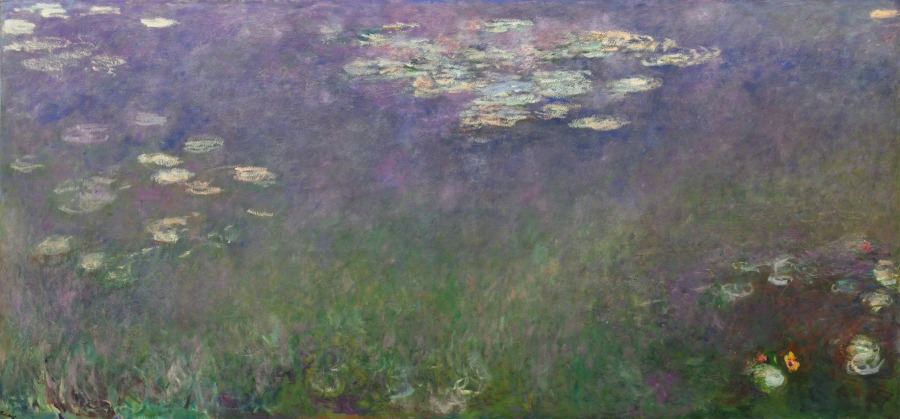
France, late 19th century-early 20th century · c. 1915–26
Water Lilies (Agapanthus)
Claude Monet
Dudley P. Allen Fund · The Cleveland Museum of Art
Image: public domain (CC0) · Museum record & image source ↗
Dada was a literary and art movement that began in Europe during World War I. It was characterized by cynicism, expressions of outrage at the conditions of the world, and rebellion against all established artistic conventions and traditional art forms. In 1919 Kurt Schwitters developed his own version of Dada named Merz which took the form of poetry, public recitals of nonsense, and collages. The verbal juxtapositions of unrelated words in his poems had a visual equivalent in compositions made up of bits of paper—urban debris that the artist avidly collected from the city streets. According to Schwitters, "Merz was the second syllable of Kommerz . . . it was cut out and glued on from an advertisement for the Kommerz und Privatbank (Commercial and Private Bank)." The six lithographs in the Merzmappe were made at the Molling printing plant where Schwitters salvaged recently printed material like patterned pieces of paper, parts of illustrations, cigarette wrappers, advertisements, and letters. He made collages of these freshly printed papers while they were still wet with oily printing ink and transferred the images to the lithographic stone.
Collection text · The Cleveland Museum of Art · CC0Start with what you can see: shapes, surface, colour and scale. How might the listed materials affect the way this object was made and experienced?
Looking prompt · an invitation to observe, not a historical interpretation.