 ↗
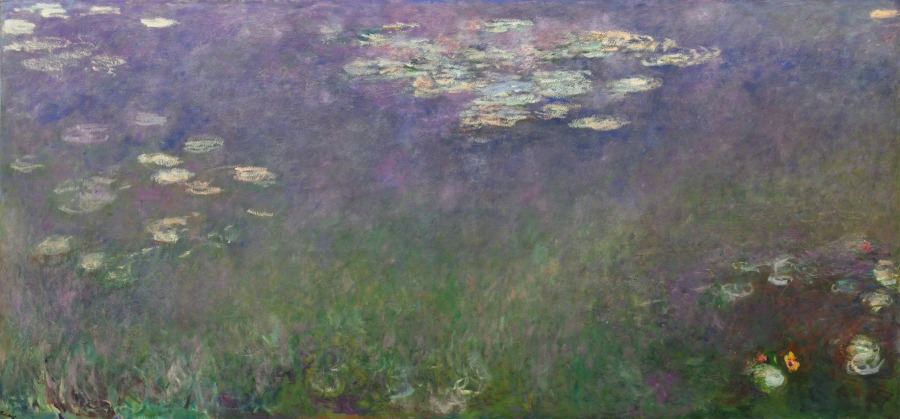
France, late 19th century-early 20th century · 约1915—1926年
睡莲(百子莲)
克洛德·莫奈
#0E1012#131416#272423#1A1D21#98897D#443E3B根据博物馆图像中的六组色彩估算,包含可见纸张或边框。复制方式和光照会影响结果;这里显示的是图像面积占比,而非颜料用量。
Hinman B. Hurlbut Collection · 克利夫兰艺术博物馆
图像:公共领域(CC0)· 博物馆记录与图像来源 ↗
George Bellows
Bellows was no stranger to Sharkey’s Athletic Club, a raucous saloon with a backroom boxing ring, located near his studio. Founded by Tom “Sailor” Sharkey, an ex-fighter who had also served in the US Navy, the club attracted men seeking to watch or participate in matches. Because public boxing was illegal in New York at the time, a private event had to be arranged in order for a bout to take place. Participation was usually limited to members of a particular club, but whenever an outsider competed, he was given temporary membership and known as a “stag.” Although boxing had its share of detractors who considered it uncouth at best or barbaric at worst, its proponents—among them President Theodore Roosevelt—regarded it a healthy manifestation of manliness. Around the time Bellows painted Stag at Sharkey’s, boxing was moving from a predominantly working-class enterprise to one with greater genteel appeal. For some contemporaries, boxing was a powerful analogy for the notion that only the strongest and fittest would flourish in modern society.
馆藏文字 · 克利夫兰艺术博物馆 · CC0从眼前可见之处开始:形状、表面、色彩与尺度。所列材料可能怎样影响作品的制作方式与观看体验?
观看提示 · 邀请你观察,而非对历史的定论。