生平与创作经历
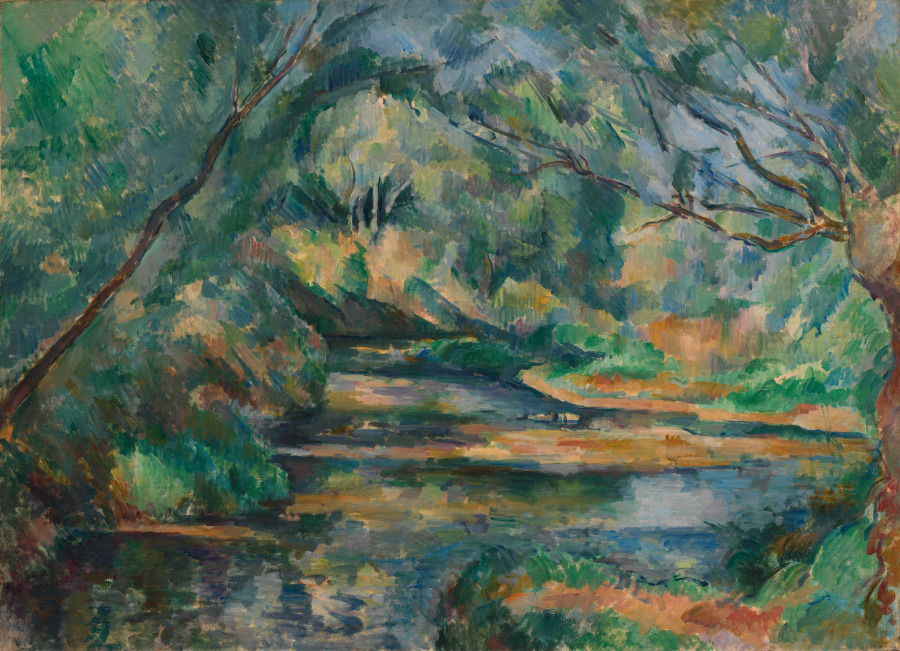
塞尚在巴黎与普罗旺斯之间发展创作,与印象派对话,却不能被其完全概括。他反复研究静物、浴者及艾克斯附近风景,晚期探索如何以色彩和变化观察建立画面,而不依赖单一固定视点。
博物馆传记原文(英文)
The son of a wealthy banker, Cézanne began his studies in Aix-en-Provence at the École Saint-Joseph in 1849, then attended the Collège Bourbon from 1852 until 1858. Émile Zola, the future author, was to become one of his closest friends. Cézanne enrolled at the École Gratuite de Dessin in 1857, entering the studio of Joseph Gibert (1806-1884). Two years later, complying with his father's wishes, he began studying law at the Université d'Aix while still at the École Gratuite de Dessin. In 1861 Cézanne finally left law school and followed Zola to Paris where he met Pissarro (q.v.) at the Académie Suisse. Probably after his failure to enter the École des Beaux-Arts, he returned to Aix and began working at his father's bank. In 1862, however, Cézanne returned to Paris, where he studied at the Académie Suisse and copied the works of the Old Masters in the Louvre. The works he produced during this period reflect the influence of Spanish painters such as Ribera (1591-1562) and Zurbarán (1598-1664), and other predecessors such as Delacroix (q.v.). His submissions to the Salons of 1865 through 1870 (and even through 1881) did not receive the jury's approval; the reinstatement of the Salon des Refusés was repeatedly but unsuccessfully demanded. Cézanne traveled often between Aix and Paris until 1870. To escape the Franco-Prussian War (1870-71) he stayed in the south in L'Estaque, along with his mistress, Hortense Fiquet, whom he had met in 1869. Cézanne moved back north to Pontoise with Hortense and his son, Paul, in 1872 and worked with Pissarro and met Dr. Paul Gachet. The following year he moved again to nearby Auvers-sur-Oise with his family, continuing his work with Pissarro. In 1874 and 1877 Cézanne participated in the first and third impressionist exhibitions, but the severe criticism of his works led him to abstain from using this venue again. In 1878 his father learned of the existence of Hortense and Paul, who at that point were living in Marseille, and threatened to discontinue his allowance. While in the Midi, Cézanne often worked with Monticelli (q.v.). His art increasingly matured, and he began concentrating on the order and internal structure within his compositions, limiting his palette. During these years he also met Gauguin (q.v.) and Renoir (q.v.), and always trav-eled, chiefly between Aix and L'Estaque. In 1886 Cézanne married Hortense, his father died, and the inheritance provided him with the financial means to live without constraints. He bought a house in Marlotte near Fontainebleau in 1892. In 1895 he had his first solo show at the gallery of Ambroise Vollard, who two years later bought all the artist's works from his studio near Corbeil. The dealer Paul Durand-Ruel became another important client. Cézanne participated in the Salon des Indépendants in 1899, 1901, and 1902 and exhibited at La Libre Esthétique in Brussels in 1901 and 1904, the Secession in Vienna in 1903, and the Salon d'Automne in 1904-6. He continued to study the underlying structure of nature, at times approaching abstraction by denying traditional perspective and using multiple viewpoints. He also began leaving portions of the canvas bare, giving some works an unfinished appearance. Cézanne's work had a tremendous influence on the artists of his time as well as those of subsequent generations, and he is considered one of the most influential figures in the development of modern art.
艺术家传记 · 克利夫兰艺术博物馆 · CC0生涯作品选读
所选作品并非完整目录。推断生涯顺序之前,请先阅读日期范围及作者归属。
- 01
1871–76
- 02
1890
1890
贝尔维尤的鸽楼
- 材料与技法
- 织物面油画
- 作者归属与角色
- 博物馆归属记录
- 收藏与来源
- 克利夫兰艺术博物馆
博物馆原文说明
Paul Cezanne painted this composition in three horizontal planes: the azure blue of the sky; the luminous white of the tower and the farmyard buildings; and the burnt-orange shade of the foreground earth, whose color is indicative of the iron-rich soil of Provence. The shimmering greens of Cezanne’s favorite cypress and olive trees are interspersed across the middle ground. The composition is pared down to its essentials, devoid of extraneous detail; it exemplifies his ambition “to make something solid and enduring, like the art in museums.”
馆藏文字 · 克利夫兰艺术博物馆 · CC0 - 03
c. 1904
c. 1904
圣维克多山
- 材料与技法
- 织物面油画
- 作者归属与角色
- 博物馆归属记录
- 收藏与来源
- 克利夫兰艺术博物馆
博物馆原文说明
During the last 20 years of his life, Cezanne repeatedly painted Mount Sainte-Victoire near his home in Aix-en-Provence in southern France. Cezanne painted this view from life at one of his favorite sites, a small road that led from Aix eastward toward Mount Sainte-Victoire. He set up his easel at the edge of the road where he could see two umbrella pines and the mountain towering over the scene. A branch of one of the pines extends from the left of the canvas across the sky, echoing the slope of the mountain, linking the near and the far.
馆藏文字 · 克利夫兰艺术博物馆 · CC0
媒介、笔触与色彩
媒介与表面
素描与油画始终是互补的形态及位置研究。
笔迹与结构
反复调整轮廓与色块形成深度,同时保留工作痕迹。
色彩与光线
冷暖关系构成平面,色彩参与结构,而非只给轮廓内部上色。
资料来源与延伸阅读
本项目原创教育性阐释;馆藏原文另行注明。每件选例均链接来源,未展示图像的参考条目不加入比较时间轴。