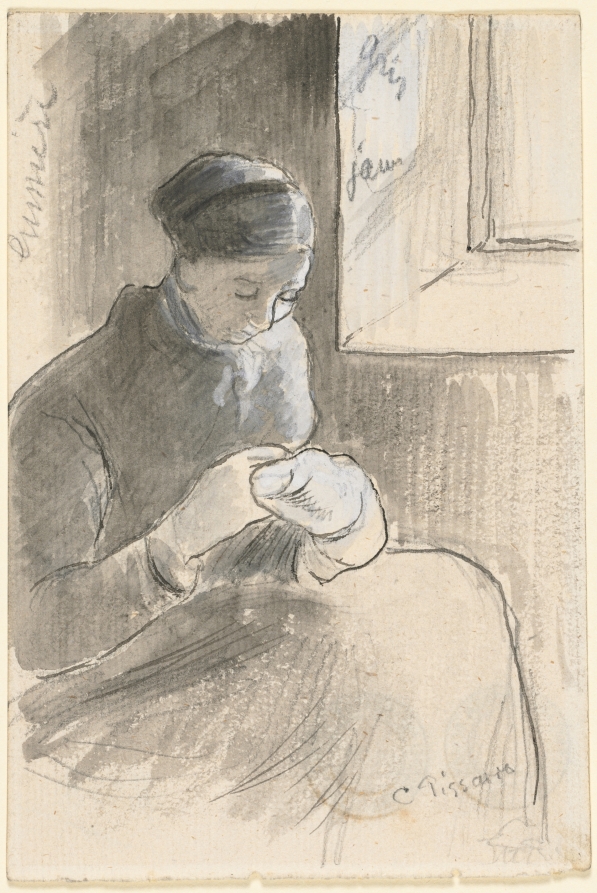
生平与创作经历
毕沙罗生于加勒比地区,主要在法国发展艺术事业,是印象派展览持续的参与者,也支持年轻画家。题材从乡村劳动与村庄风景延伸到后期城市景观,并曾实验新印象派色彩方法。
博物馆传记原文(英文)
Camille Pissarro's parents ran a general merchandise business on St. Thomas. After attending boarding school in Paris, Pissarro returned to the West Indies to work for his father from 1847 until 1852. As an artist he was largely self-taught, receiving some instruction from Fritz Melbye (1826-1896), a Danish artist with whom he traveled to Venezuela in 1852. When Pissarro returned to Paris in 1855, he shared a studio with Anton Melbye (1818-1875), Fritz's brother, and with David Jacobsen (1821-1871). He took classes at the École des Beaux-Arts in 1856 and three years later attended the Académie Suisse, where he befriended artists such as Cézanne (q.v.), Monet (q.v.), and Guillaumin (q.v.). Corot (q.v.) encouraged him to paint landscapes around Paris, and he was listed as Corot's pupil in the catalogues of the Salons of 1864 and 1865. He had met Julie Vellay in 1860, with whom he would have eight children; they married in 1871. Pissarro exhibited regularly at the Salons from 1859 to 1870, although his work received little attention and he sold hardly anything. In 1866 he settled in Pontoise, often returning to Paris where he kept a studio. He frequented Émile Zola's "Thursdays" (weekly literary gatherings) and associated with Manet's (q.v.) artistic circle that gathered in the Café Guerbois. During the Franco-Prussian War (1870-71) Pissarro fled with his family, first to Montfoucault and then to London, where he worked with Monet and Daubigny (q.v.) and was introduced to the dealer Durand-Ruel. In 1872 he returned to Pontoise, where he painted with Cézanne. Around 1869 Pissarro began painting in a purely impressionist style, and in 1874 he helped organize the first impressionist exhibition. He moved to Éragny-sur-Epte in 1884, where he came into contact with Seurat (q.v.) and Paul Signac (1863-1935) and subsequently began to work in a pointillist style. He eventually found this technique too limiting, and returned to an impressionist mode, often working in series. By the end of his career his landscapes and depictions of city life sold well, and in 1892 he was given a retrospective exhibition at Durand-Ruel. By now, the artist had developed strongly anarchist convictions. Pissarro not only painted and made drawings, he also experimented with etching and lithography.
艺术家传记 · 克利夫兰艺术博物馆 · CC0生涯作品选读
所选作品并非完整目录。推断生涯顺序之前,请先阅读日期范围及作者归属。
- 01
1866
1866
拉罗什-吉永
- 材料与技法
- 蚀刻
- 作者归属与角色
- 博物馆归属记录
- 收藏与来源
- 克利夫兰艺术博物馆
博物馆原文说明
A very early etching by the Impressionist artist Camille Pissarro, this view of the massive rocks at La Roche-Guyon reveals the artist’s painterly attitude toward printmaking. Using only the etched line and a layer of ink left on his printing plate's surface, Pissarro created a dramatic landscape filled with brilliant sunlight and soft shadows.
馆藏文字 · 克利夫兰艺术博物馆 · CC0 - 02
1872
1872
蓬图瓦兹的船闸
- 材料与技法
- 织物面油画
- 作者归属与角色
- 博物馆归属记录
- 收藏与来源
- 克利夫兰艺术博物馆
博物馆原文说明
Pissarro was instrumental in developing the radically new Impressionist technique of painting quickly outdoors to capture fleeting effects of light and atmosphere. The rushing water and overcast sky in this view of a river lock near the artist’s home at Pontoise, a rural commune about 17 miles northwest of Paris, are rendered with rapid, broken brushstrokes of pure color. Painting directly on canvas without preliminary drawing, Pissarro may have executed this work in a single session. The shimmering surface of broken color conveys the sensation of natural, outdoor light.
馆藏文字 · 克利夫兰艺术博物馆 · CC0 - 03
1879
1879
蓬图瓦兹埃尔米塔日附近的林缘
- 材料与技法
- 织物面油画
- 作者归属与角色
- 博物馆归属记录
- 收藏与来源
- 克利夫兰艺术博物馆
博物馆原文说明
Born to a French-Jewish family on St. Thomas island in the Caribbean, Pissarro painted this monumental landscape when he was desperately poor and struggling to sell his paintings. It depicts a man slumbering in the sun-dappled backwoods of the Hermitage, a rural village near Pontoise, where the artist had been living since 1872. Restricting his palette to pure hues, Pissarro applied brushstrokes in systematic diagonal patterns, producing an effect that he likened to knitting. This canvas was included in the fourth Impressionist exhibition of 1879.
馆藏文字 · 克利夫兰艺术博物馆 · CC0 - 04
1902
1902
鱼市
- 材料与技法
- 布面油画
- 作者归属与角色
- 博物馆归属记录
- 收藏与来源
- 克利夫兰艺术博物馆
博物馆原文说明
This impressive view of a bustling fish market belongs to a series of paintings that Pissarro made during the summer of 1902 depicting the harbor at Dieppe. Borrowing from the Impressionist method of portraying a modern city from a high vantage point, he enlivened the scene with rich, vibrant colors applied with energetic, broken brushstrokes. Ever concerned with the fleeting effects of atmosphere, Pissarro painted the interpenetration of industrial steam with the clouds in the brilliant, sunlit sky.
馆藏文字 · 克利夫兰艺术博物馆 · CC0
媒介、笔触与色彩
媒介与表面
风景绘画与城市版画,持续关注日常环境。
笔迹与结构
细小重复笔迹组织植物、建筑及人物活动,同时保留差异。
色彩与光线
明暗及色彩关系联系天地,分色实验只是一个阶段,并非永久规则。
资料来源与延伸阅读
本项目原创教育性阐释;馆藏原文另行注明。每件选例均链接来源,未展示图像的参考条目不加入比较时间轴。