↗
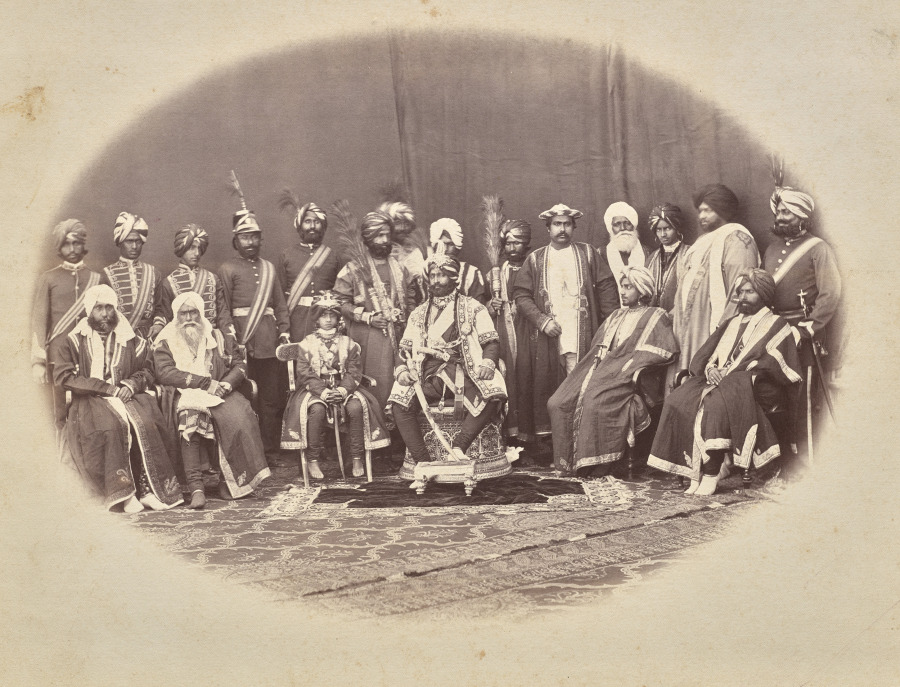
印度 · 1878
从岩顶俯瞰印度特里奇诺波利城镇
尼古拉斯摄影公司
#6B504E#C2A362#CCC4B0#A77E58#C3B998#77786A根据博物馆图像中的六组色彩估算,包含可见纸张或边框。复制方式和光照会影响结果;这里显示的是图像面积占比,而非颜料用量。
Edward L. Whittemore Fund · 克利夫兰艺术博物馆
图像:公共领域(CC0)· 博物馆记录与图像来源 ↗
博物馆未记录创作者
This painting is from an important series made at a turning point in the history of court painting at the Rajput kingdom of Mewar. For the first time, a royal patron, Amar Singh II (r. 1698–1710), even before his accession to the throne, decided to incorporate Mughal elements into secular art, as seen in the white domed architecture and interest in conveying some sense of spatial depth. Nevertheless, the artist still adheres to the use of horizontal registers and bold planes of color. The codified iconography of Shri Raga involves a royal couple listening to recitations. Shri Raga is described as: "Splendidly enthroned of peerless beauty and lovely as the autumn moon, he sits hearing stories from Narada and Tumburu. By the great sages he is called Shri Raga King." Amar Singh has playfully substituted his own portrait for that of the generic king, and a woman for that of the sage. In music, Shri Raga is associated with the season of autumn and the harvest festivals, here evoked by the dancing female musicians in the lower register.
馆藏文字 · 克利夫兰艺术博物馆 · CC0从眼前可见之处开始:形状、表面、色彩与尺度。所列材料可能怎样影响作品的制作方式与观看体验?
观看提示 · 邀请你观察,而非对历史的定论。