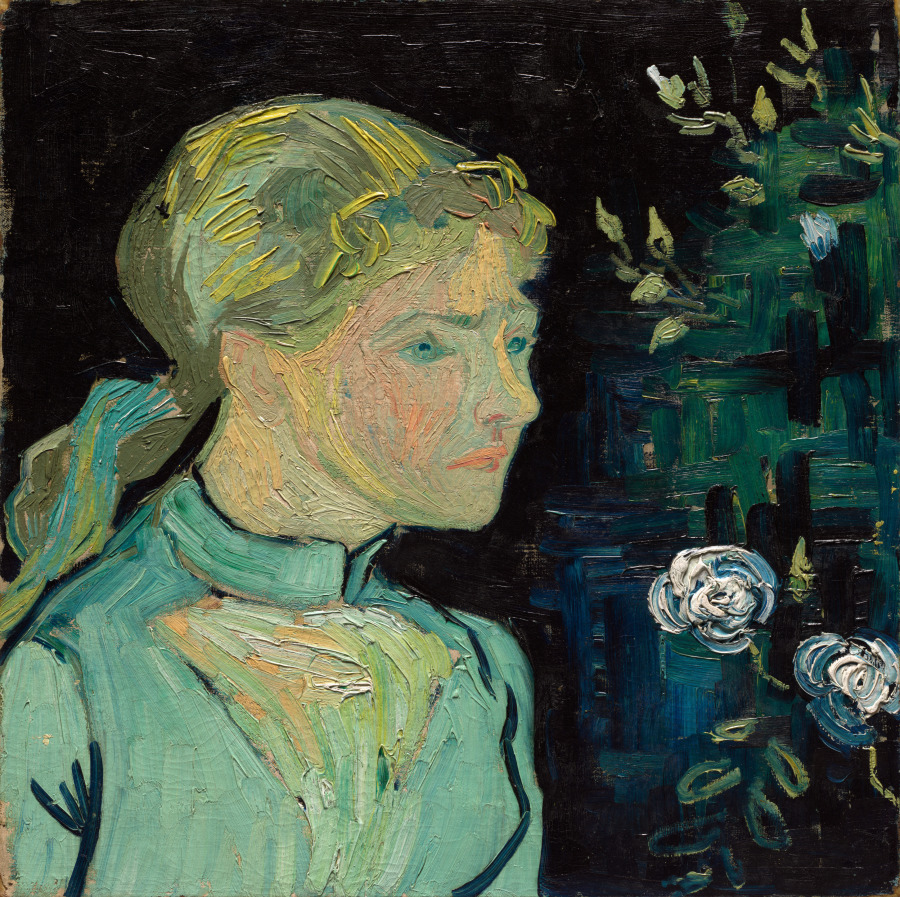
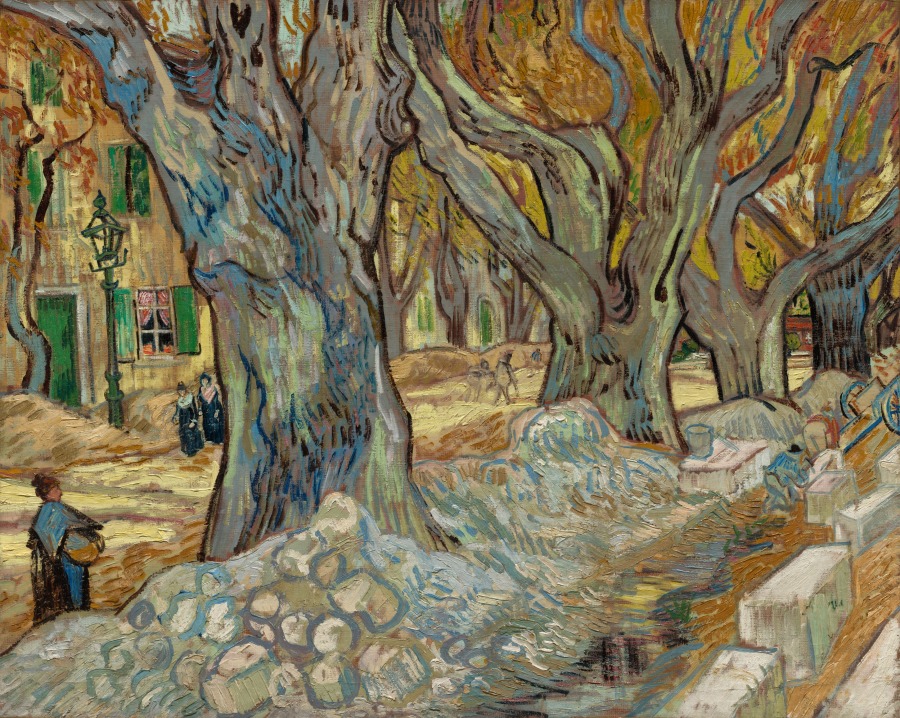
生平与创作经历
梵高成年后投入艺术,最初在荷兰研究素描与乡村劳动。巴黎的接触改变了色彩及用笔,南法时期发展出节奏强烈的风景和肖像。最后数年曾在圣雷米接受治疗,并在奥维尔工作,创作唯一一件蚀刻。
博物馆传记原文(英文)
The son of a clergyman, Vincent van Gogh was sent to The Hague at the age of sixteen to become an apprentice at Goupil & Co., an art dealer with whom his uncle was affiliated. In August 1872 van Gogh began his extensive correspondence with his younger brother Theo, who would join the Brussels branch of the firm the following year. Vincent was transferred to the London offices in 1873 and two years later to the Paris office, but he despised the art trade and was dismissed in 1876. He then taught briefly at a boarding school in Ramsgate and Isleworth, and, back in the Netherlands, worked in a bookshop in Dordrecht before moving to Amsterdam to study theology. In little more than a year he had left the university and entered missionary school, failing again. Still intent on entering the ministry, he moved to the Borinage in Belgium and became a lay evangelist to the miners. Van Gogh finally decided to become an artist in August 1880 and started copying works by Millet (q.v.), the painter of peasant life. With his brother's financial help, he briefly joined the Academy in Brussels. The following year he returned to The Hague, where he received some artistic training from his cousin by marriage, Anton Mauve (1838-1888). There van Gogh met Sien Hoornik, a pregnant prostitute with a five-year-old daughter, with whom he lived briefly. Unable to marry her because of his family's disapproval, he moved in November 1883 from The Hague to the province of Drenthe, a popular place for artists, where he painted and drew laborers and peasants. Feeling terribly lonely, he visited his parents in December 1884 in Nuenen, and it was there that he finally decided to become a painter of peasant life. Van Gogh completed The Potato Eaters (Van Gogh Museum, Amsterdam) in April 1885 and sent it to his brother in Paris. On 25 November he moved to Antwerp, where he reveled in the work of Rubens and first came to know Japanese prints. Van Gogh traveled to Paris in March 1886 and lived with Theo. Under the influence of the impressionists, and works by Monticelli (q.v.), his palette changed to more intense and vibrant colors. He began to associate with Émile Bernard (1868-1941), Henri de Toulouse-Lautrec (1864-1901), Degas (q.v.), Gauguin (q.v.), Pissarro (q.v.), and Seurat (q.v.) and started collecting some of their paintings as well as Japanese prints. He moved to Arles in February 1888. Apart from paintings, he also made some drawings because it was a cheaper medium. Theo encouraged him to submit to the Salon des Indépendants. In May Vincent rented a room in the Yellow House, even though he could hardly afford to do so, and continued to send his work to his brother. In June he became intrigued with the subject of the wheat harvest and painted The Sower (Kröller-Müller Museum, Otterlo). On 23 October 1888, Gauguin arrived in Arles, at a time when van Gogh was having trouble with his eyesight. Gauguin encouraged him to paint from memory, which resulted in Memory of the Garden in Etten (Hermitage, St. Petersburg). The artists, however, had many disagreements, and during a dramatic quarrel on 23 December van Gogh mutilated his ear. He was taken into a hospital in Arles, and Gauguin left for Paris. Van Gogh recovered rapidly and was dismissed on 7 January 1889. In February his neighbors objected to his presence in the Yellow House, and he had to return to the hospital. In April Theo married Johanna Gesina Bonger, who would eventually safeguard most of Vincent's oeuvre. Aware of his mental problems, at the end of April van Gogh checked himself into the asylum of Saint-Paul-de-Mausole in Saint-Rémy, where he was treated by Dr. Peyron. His condition was stable, and he was allowed to work in a makeshift studio. He worked in the garden (Irises, J. Paul Getty Museum, Los Angeles) and painted the fields he could see from his window. Under supervision he painted in the countryside, rendering cypresses and olive trees. Starry Night (Museum of Modern Art, New York) also stems from this period. From July through September he suffered from a severe depression that prevented him from working. He resumed his work from October through December, painting well-known Provençal works and adapting prints after Delacroix (q.v.), Millet, and Rembrandt (1606-1669). In January 1890 he exhibited five works with Les XX in Brussels, selling one of them. After a visit to Arles at the end of February, he became ill again but continued to work. He finally left the asylum, and visited Theo in Paris on his way to Auvers, where he arrived on 20 May. He became close friends with Dr. Gachet and rented a room at the inn of the Ravoux family. He painted the village, portraits, and the surrounding wheat fields. On 27 July 1890, during an episode of depression, van Gogh shot himself in the chest and died two days later.
艺术家传记 · 克利夫兰艺术博物馆 · CC0生涯作品选读
所选作品并非完整目录。推断生涯顺序之前,请先阅读日期范围及作者归属。
- 01
1883
1883
有独轮车的风景
- 材料与技法
- 奶油色纸水彩、不透明水彩与黑粉笔
- 作者归属与角色
- 博物馆归属记录
- 收藏与来源
- 克利夫兰艺术博物馆
博物馆原文说明
In September 1883 Van Gogh left the bustling Dutch city of The Hague in search of open countryside in which to paint. He moved to Drenthe, a village in northeastern Netherlands that was virtually untouched by the Industrial Revolution. He described the barren terrain as supremely beautiful and serene: "What tranquility, what expanse, what calmness in this nature." With a limited palette of steely greens and cool blues, Van Gogh masterfully portrayed one of the region’s expanses of heath—"a vast plane vanishing into infinity"—illuminated by the lilac hues of the evening sky.
馆藏文字 · 克利夫兰艺术博物馆 · CC0 - 02
1889
1889
圣雷米附近阿尔皮耶的两棵白杨
- 材料与技法
- 织物面油画
- 作者归属与角色
- 博物馆归属记录
- 收藏与来源
- 克利夫兰艺术博物馆
博物馆原文说明
Vincent van Gogh painted this autumnal landscape while interned at a psychiatric hospital near Saint-Rémy in southern France. Although initially restricted to painting in his room, he soon resumed working outdoors. This painting reveals the full power of his mature style. Trees twist and lean against a darkening sky, while the intense colors applied with charged brushstrokes convey his emotional reaction to the subject.
馆藏文字 · 克利夫兰艺术博物馆 · CC0 - 03
1890
1890
加歇医生
- 材料与技法
- 帘纹纸蚀刻与干刻,黑墨加强
- 作者归属与角色
- 博物馆归属记录
- 收藏与来源
- 克利夫兰艺术博物馆
博物馆原文说明
This portrait of Dr. Paul Gachet, made just two months before the artist’s death, is the only etching that Vincent van Gogh created. Van Gogh placed himself under the care of Gachet in Auvers-sur-Oise, a small village on the northern outskirts of Paris, at the recommendation of fellow artist Camille Pissarro. The doctor was himself an amateur printmaker and gave Van Gogh a varnished copper plate, helping him print it on his own small hand press. For his first attempt, Van Gogh depicted Gachet seated in his garden smoking a pipe.
馆藏文字 · 克利夫兰艺术博物馆 · CC0
比较材料、风格与色彩
1883年的水彩与粉笔风景以土色明暗构成,1889年油画则以色彩及方向性笔触激活表面。《加歇医生》中,蚀刻和干刻线条取代颜料色彩,说明晚年实验并非放弃素描或必然走向更鲜艳的绘画。
材料
这种材料能产生什么效果?请区分设计、原物与后来的印本或铸件。
风格
比较视点、边缘、构图及笔迹。哪些选择持续存在,哪些发生变化?
色彩
比较调色、对比及光线,同时考虑载体、印刷、表面处理与老化。
资料来源与延伸阅读
本项目原创教育性阐释;馆藏原文另行注明。每件选例均链接来源,未展示图像的参考条目不加入比较时间轴。